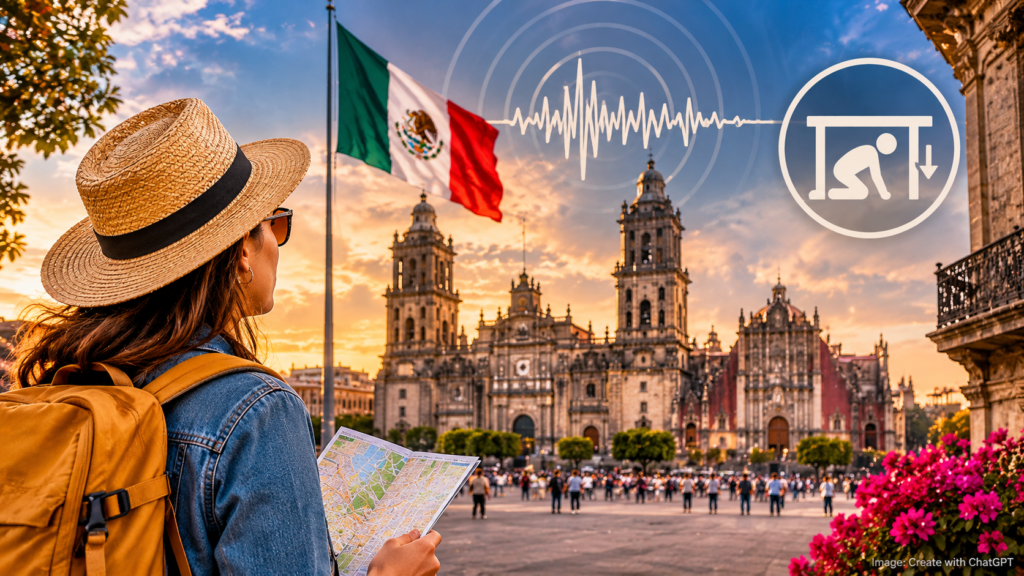

Welcome to Mexico City—an incredible metropolis packed with unbeatable street food, world-class museums, vibrant neighborhoods, and stunning architecture.
It is also a city where the ground occasionally shakes. That is why knowing what to do and this Mexico City Earthquake Safety Guide help you to enjoy your trip to the fullest, relax, and take home the best memories.
Just like on any great trip, having the right information makes all the difference.
You have likely heard that earthquakes happen in Mexico.
This is not a myth: the country sits on the Pacific Ring of Fire, one of the most seismically active zones on the planet. As a result, shifts in the Earth’s crust create vibrations felt as shaking or swaying.
There is no need to panic.
Mexico City has a deeply ingrained culture of preparedness and prevention. Whether you are touring the iconic Ciudad Universitaria campus in the south of the city—a must-see on any itinerary—or exploring any other neighborhood, this practical guide covers exact safety protocols based on the official guidelines of the National Autonomous University of Mexico (UNAM).
What to Do During an Earthquake in Mexico City?
Use this Mexico City Earthquake Safety Guide
Before It Happens: Preparation Is Your Best Ally
Whenever you walk into a museum, a restaurant, or the halls of the School of Engineering at Ciudad Universitaria, take a few seconds to scan your surroundings:
- Look for green safety signs and check the evacuation maps posted near entrances and hallways.
- Identify the nearest evacuation routes, emergency exits, and signs marking the Zona de menor riesgo (Lowest-Risk Zone).
- Keep pathways clear by never leaving backpacks, luggage, or bags blocking aisles or exits.
The Seismic Alert Sounds: What Should You Do?
Mexico City operates an advanced early warning system (Alerta Sísmica) that broadcasts a distinct loud siren over citywide loudspeakers and mobile alerts, giving you valuable seconds of advance notice before shaking starts. If you hear it, stay calm, stop what you are doing, and follow these rules based on your exact location:
- If you are on the ground floor or first floor (one level up): Walk quickly—do not run—to the nearest outdoor assembly point (Punto de reunión). If you are the first person out, prop or hold doors open for the people behind you.
- If you are on the second floor or higher: Do not try to run down the stairs. If it will take you more than one minute to exit the building, move to the nearest Lowest-Risk Zone (structurally solid areas such as load-bearing walls or main columns) and shelter in place.
- Protect your head: Cover your head and neck with your arms or a bag to shield yourself from falling objects.
- What NEVER to do: Never use elevators under any circumstances. Stay away from windows, hanging lamps, shelving, glass, or any heavy objects that could fall or shatter.
- If you are walking outside: Move away from power lines, streetlights, glass windows, and building facades, and head toward an open outdoor assembly point.
After the Shaking Stops: Next Steps
Once the tremor ends, follow these post-earthquake procedures to stay safe:
- Wait for official clearance: If you sheltered in place on an upper floor, wait for instructions from civil protection personnel or building safety wardens (brigadistas) before evacuating the building.
- Stay at the assembly point: Once outside, remain in the designated safe zone. Emergency brigades will inspect buildings for structural damage and check for anyone injured or trapped before declaring it safe to re-enter.
- Keep phone lines clear: Avoid spreading unverified rumors and save voice calls strictly for real emergencies. Cellular networks saturate quickly, so send a brief text message to let family and friends know you are safe.
- Local emergency contacts (UNAM area): If you are visiting the UNAM campus (CU) and experience an emergency, use the yellow campus emergency phones, call 55 5616 0523, or use the SOS UNAM mobile app.
NOTICE: For general emergencies anywhere in Mexico City, dial 911.
Being prepared and knowing what to do during an earthquake in Mexico City will not take away from the excitement of your trip—on the contrary, it gives you the peace of mind to explore every corner of the city with confidence.
Mexico welcomes you with open arms.
Enjoy the sights, take plenty of photos, and rest assured that when the unexpected happens, people here know how to look out for one another.


Síguenos y vive México